
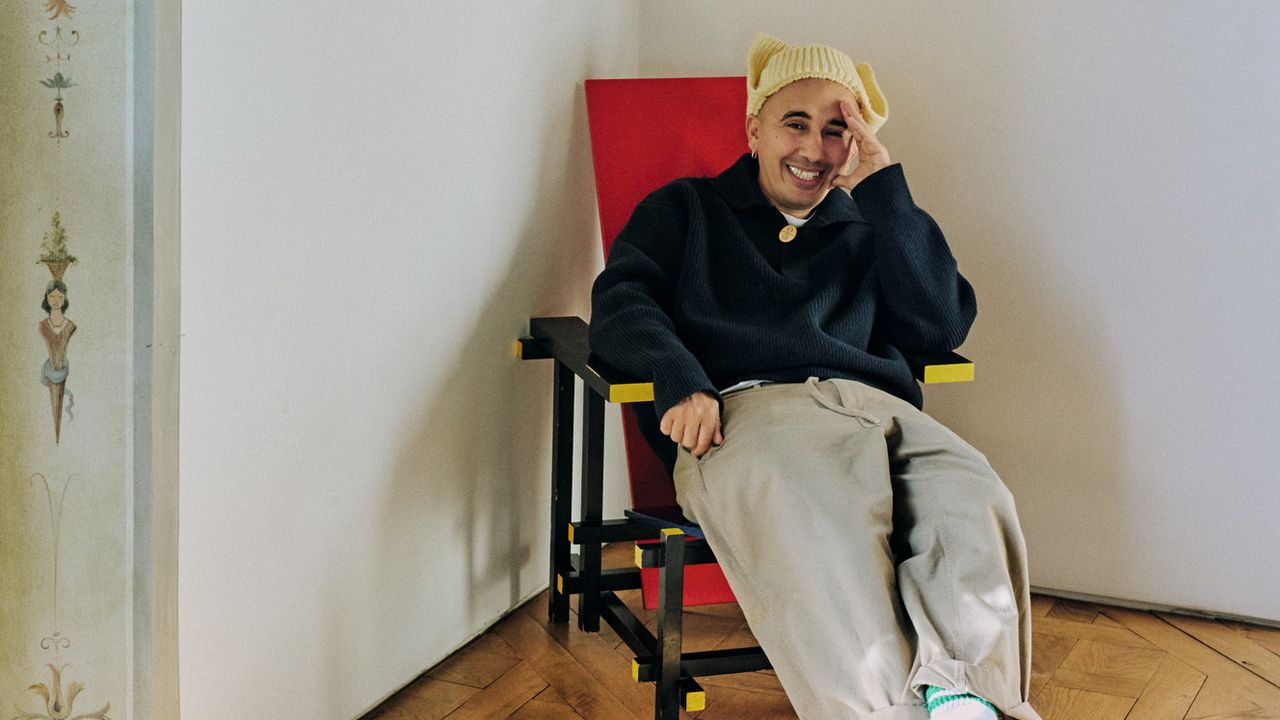

“I’m very excited about the idea of making our new flat in Rome,” Ramdane Touhami, interior designer, DJ, creative director, and artist, wrote on Instagram last August. “Making a flat that looks like a museum could be fun!” In accordance with his own briefing, Touhami chose not to downplay the scale of his project. The resulting apartment—a grand residence in Rome’s Palazzo Borghese—is indeed an architectural work worthy of a museum.
A short history of the Palazzo Borghese
Designed by the celebrated mannerist architect Giacomo Barozzi da Vignola, construction of the first sections of the late Renaissance Palazzo Borghese began in the 1560s. The Palazzo was among Vignola’s many other important projects (he became the principal architect for St. Peter’s Basilica following Michelangelo’s death). It was later expanded by Cardinal Camillo Borghese, who bought it in 1596 (in 1605, he was named Pope Paul V). The cardinal’s name then became permanently attached to the building. Today, in Touhami’s 3,014-square-foot F-shaped apartment, the soaring ceilings are still decorated with paintings and decorative frescoes from centuries past. Other intriguing details are the result of countless interventions, such as the B-shaped (for Borghese) handles on the dining-room doors which Touhami says date from the 19th century.

Touhami adds to the magic
This historic building is now the latest home of Touhami, his wife, Victoire de Taillac-Touhami, and their three children, ages 22, 20, and 18. The family has a penchant for nesting in storied builds—the couple’s Parisian apartment is in a former home of the writer Honoré de Balzac, after all. Back in Paris, the Touhamis made bold use of ebony panels, which give the illusion that a large section of burled wood is peeling away from the wall to expose decorative moldings below. While there isn’t the same sleight of hand in the palazzo, there are other magical elements. First, a surprise at the entrance: a long gallery-like atrium and hall, which Touhami has punctuated with geometric white oak furniture that he designed himself, and a group of statuettes and busts created by local art students. Along the floor and on the walls of the space are images from the book Roman Portraits, first published by Phaidon in 1940. “The faces are very contemporary,” Touhami says. “They could be people you see in the city today.”