

An appeal to the senses swept the art world in the 18th century. In the wake of rapidly evolving industrialism, the romanticist movement was a reminder of the importance of passion and beauty. It was pro individual, anti-rationalist and, in architecture, anti-neoclassical. Perhaps it’s no coincidence that romance is once again in the air, and not just because it’s almost Valentine’s Day. If the movement began as a reaction to increasing technology and its subsequent alienation, then today’s post-industrial age threatened with becoming increasingly digital and artificial creates an opportune time for romanticism’s call to connect to the self, the body, and to others.
In hospitality spaces, this has increasingly become the case. More and more, cocktail bars, lounges, and restaurants are setting the mood for intimate connections. While this new romanticism bears little resemblance to the gothic styles of its predecessors, the emphasis on the sensorial, moody lighting, and cinematic flair continue the movement’s project of evoking emotion. It makes sense given the return to events and gatherings in the wake of the COVID-19 pandemic. Perhaps this new design wave romanticizes the spaces previously off limits to us or feel increasingly challenged in an increasingly lonely world.
Across designers and projects, the amorous aesthetic takes on different facets—some are sinful, others are sleek, some even go bright and raw, but all employ visual manifestations of the locale’s aphrodisiac offerings. The following are some of the latest examples. If you’re lucky they may still have reservations for tomorrow.
Vulture by Home Studios
Home Studios puts a hedonistic spin on a new restaurant in San Diego. Hidden within the bright and airy Dreamboat Diner lies the dark and dramatic Vulture. The restaurant, helmed by Kory Stetina and Arsalun Tafazoli (who also lead Dreamboat and tapped Home Studios for the design), puts a vegan spin on American continental-style dining.
For Vulture, the studio looked to neoclassical forms. Grecian-like busts dot the interior underneath a flamboyant floral ceiling. Checkered flooring, detailed millwork, textiles by Jessi Highet, mythological motifs, and intimate booths continue the theatrical flair. Even the bathrooms remain seductive, textured with plaster and clad in moody tiles. Look closer and there’s a sense of sin in the sensorial: demons and other fantastical creatures are scattered and hidden throughout the space. Skylights set within red boxes and lighting by Home Studios realize the interior in a red, devilish glow.
Super Peach by INC Architecture & Design
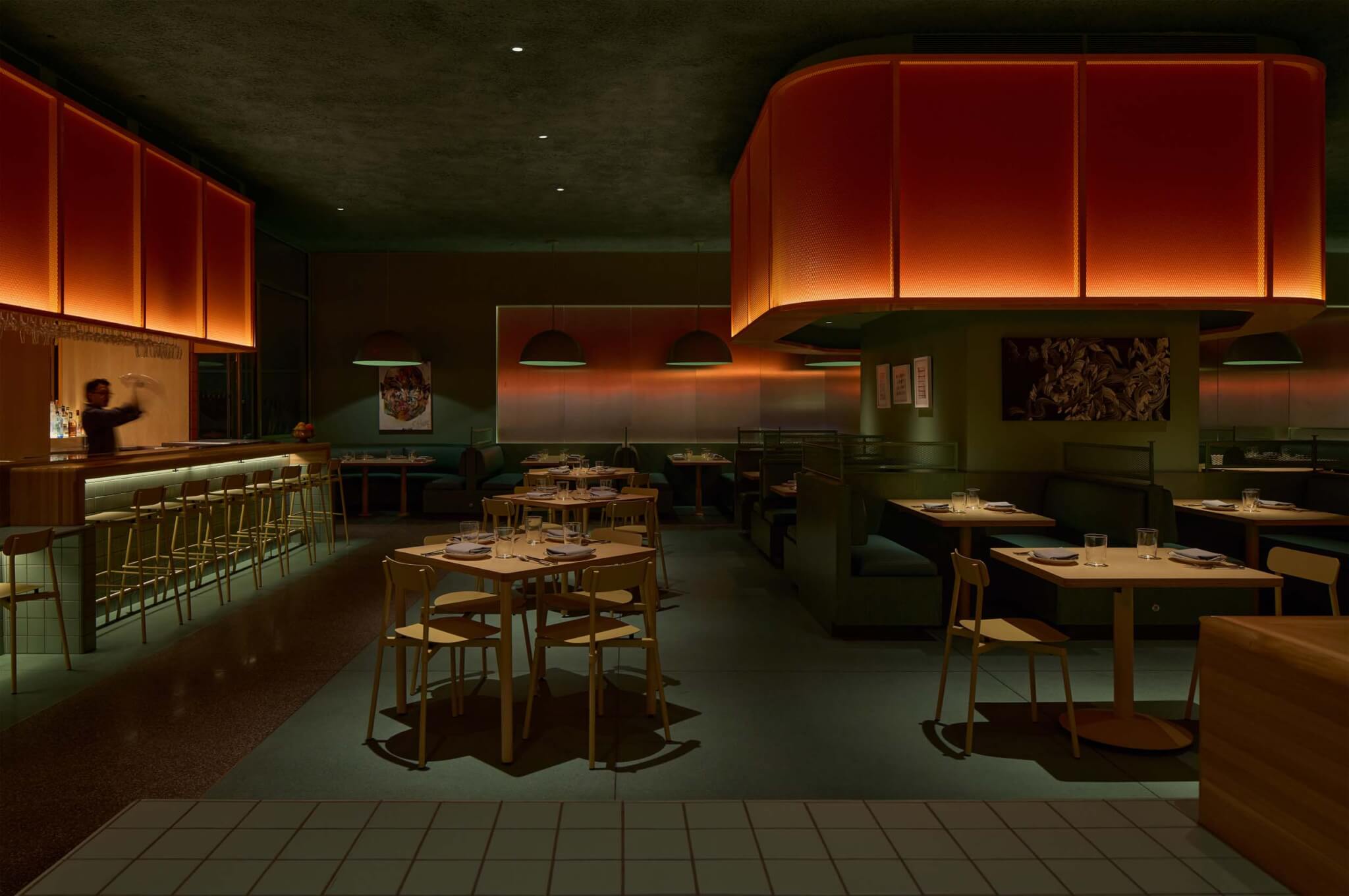
More contemporary and clean but no less moody is Super Peach. For restaurant group Momofuku’s latest venture in Los Angeles, an eatery for playful and Asian-inspired takes on American fare, INC Architecture & Design structured the outpost like a theatre-in-the-round. In other words, the firm, one of AN Interior’s Top 50 interior Architecture and Design firms, approached the organization like a culinary performance.
Horizontally, booths line the perimeter surrounding the central circulation. Vertically, the preparation counters, chef interactions, and theatrical back-lit ‘drops’ or canopies for storage offer perpendicular engagement. The color palette reinforces this arrangement using hues of the titular fruit. Everything below bar height is green, including the flooring, booths, and tile work. Above it, orange creates demarcation. The space is aglow in the warm hue thanks to a softly reflective stainless steel wrap that tops the space like a proscenium. Overhead, custom metal mesh canopies conceal lighting, acoustic treatments, and storage.
Cento Raw Bar by Brandon Miradi
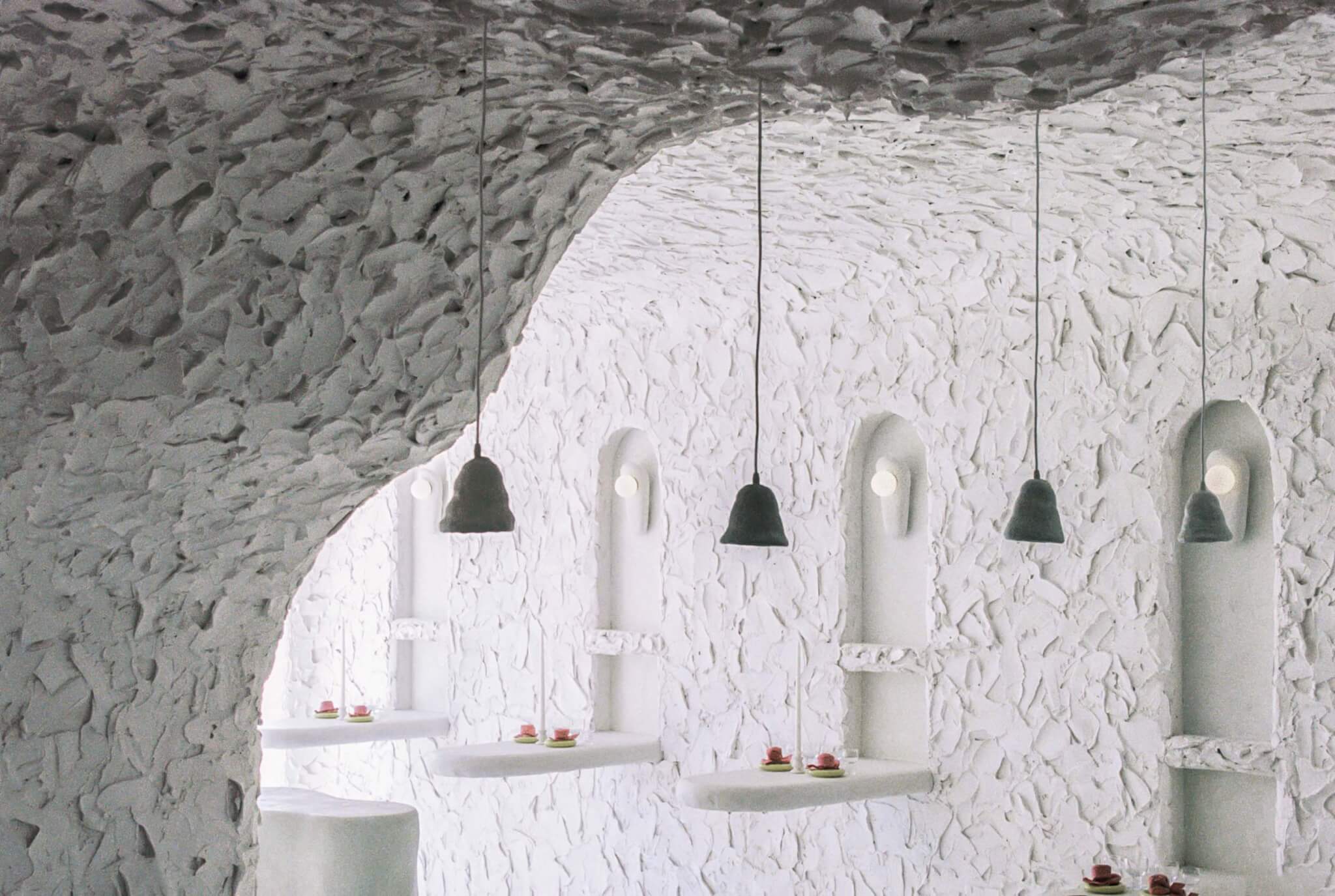
Also in Los Angeles, Cento Raw Bar offers a departure from dark lighting. To dine at Cento is to go spelunking through its cave-like interior. Helmed by chef Avner Levi and designed by creative director Brandon Miradi, the restaurant conjures an ethereal underwater cavern. Plaster and clay cover the walls, ceilings, tables, sconces, and work stations with textured brushstrokes. Miradi himself designed the technique to apply the mixture in order to achieve its seafoam texture. The application sculpts undulating soffits, columns, shelving for glassware, and tables that extend from the wall.
Mirandi choreographed every detail to match this underwater fairytale—from the plates curated to serve each dish, to the organically shaped stools in the space and the barstools whose backrests swirl like seashells. A seafoam green counter lies at the heart of the restaurant, serving up tiered seafood towers and caviar-filled burgers on chunky ceramics.
Le Specialità by Rockwell Group
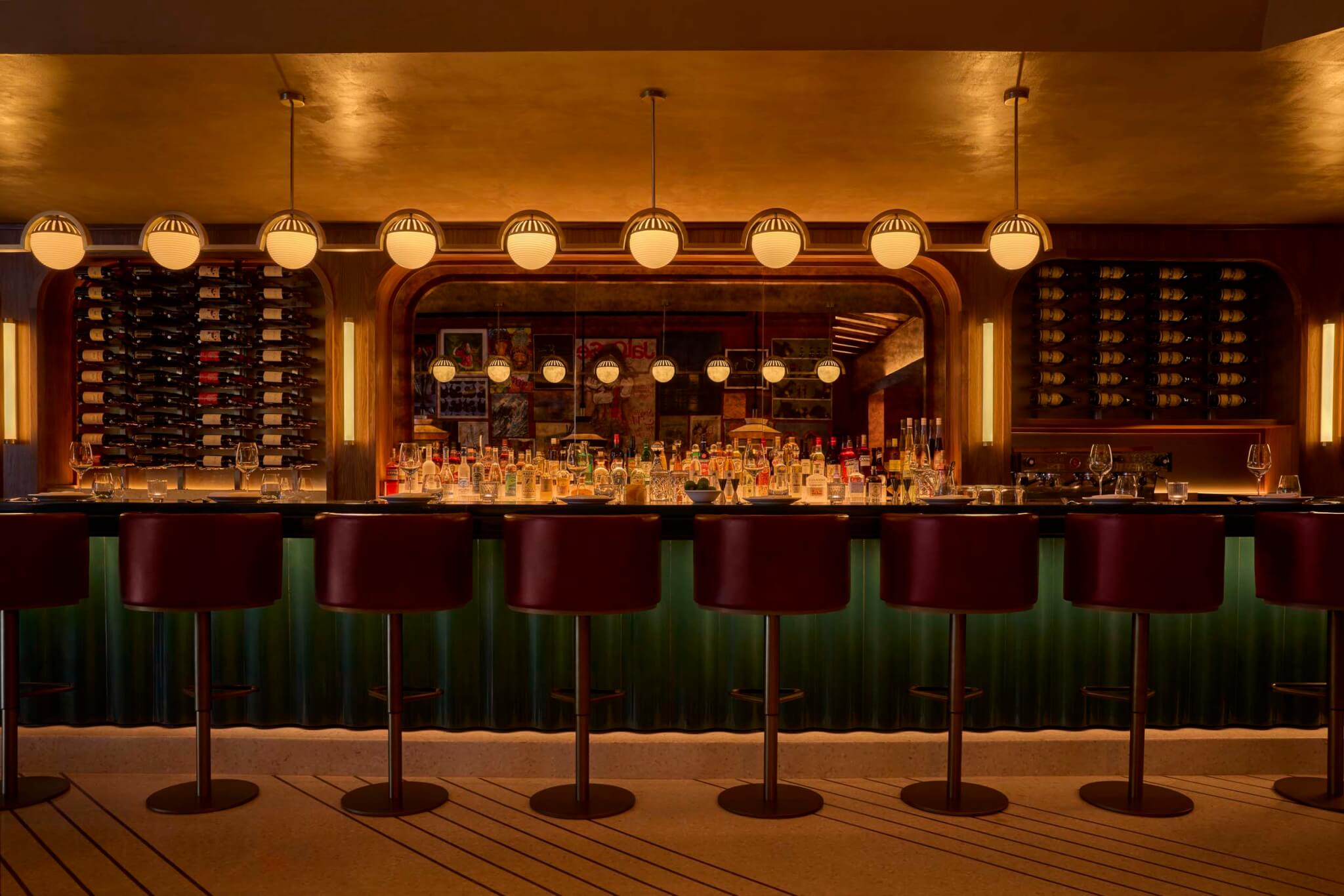
Where there’s hedonism, there’s also Miami. Milan meets Miami in Le Specialità’s first outpost in the U.S. First opened in Milan in 1977, the restaurant’s new home in Miami’s Design District marries the graphic and radical era of Milan in the ‘60s and ‘70s with the bold and playful culture of Miami. Rockwell Group worked with Artemest, the destination gallery for Italian design and decor, to bring the vision to life.
In the main dining room, patterns elegantly integrate into the moody atmosphere. Wooden beams on the ceilings create a striped pattern, mirrored by the terrazzo floors embedded with a metal stripe inlay and the vertical stripes that decorate Artemest’s Calypso Martinique pendant lamps. Striations collide with a wall of art, including works by KAWS, Takashi Murakami, and Rashid Johnson, and an abstract black and white terrazzo pattern that clads the pizza oven. A green lavastone bar and red leather barstools add luxurious layers to the playful approach.
Obvio by Santa Cruz Co
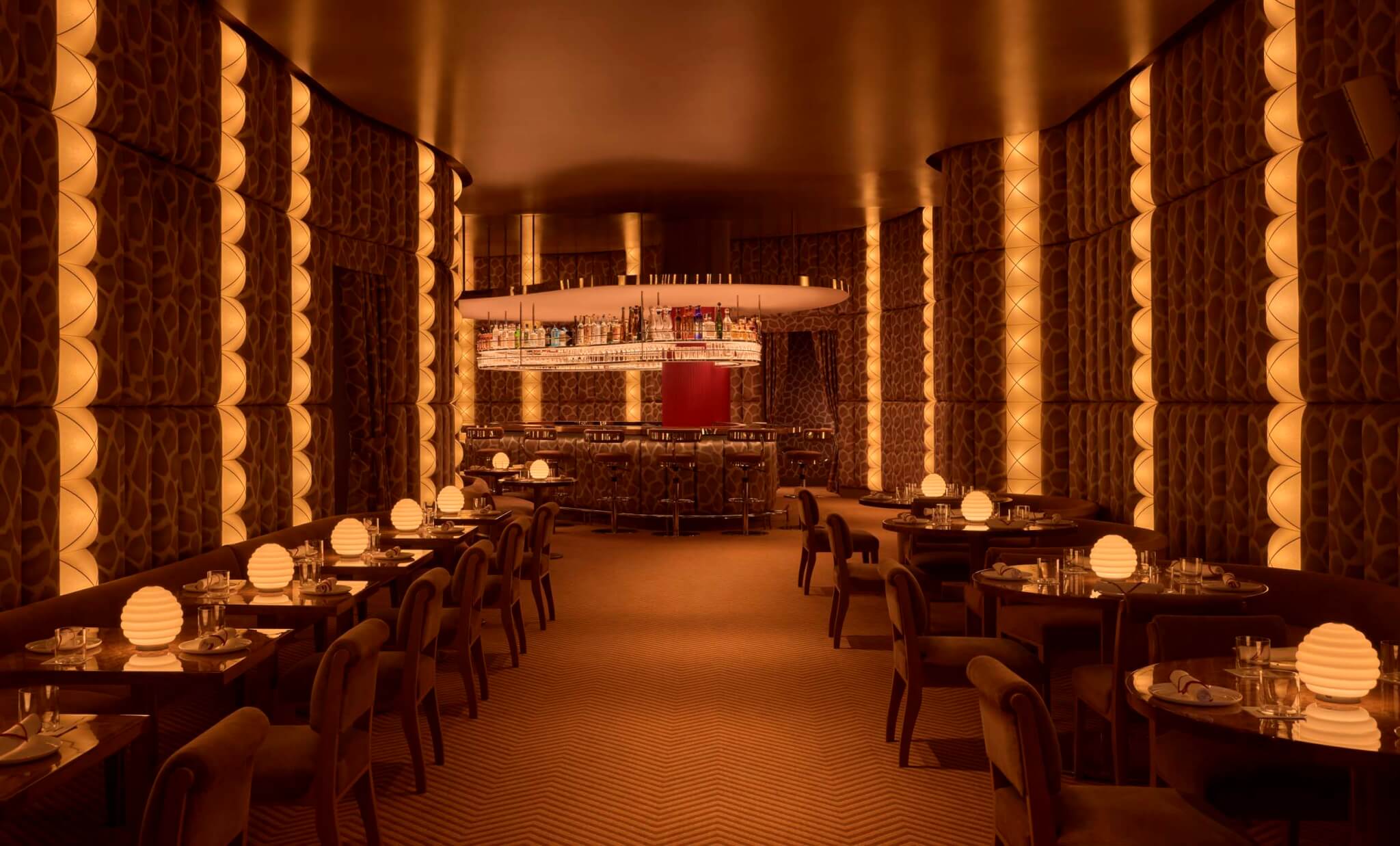
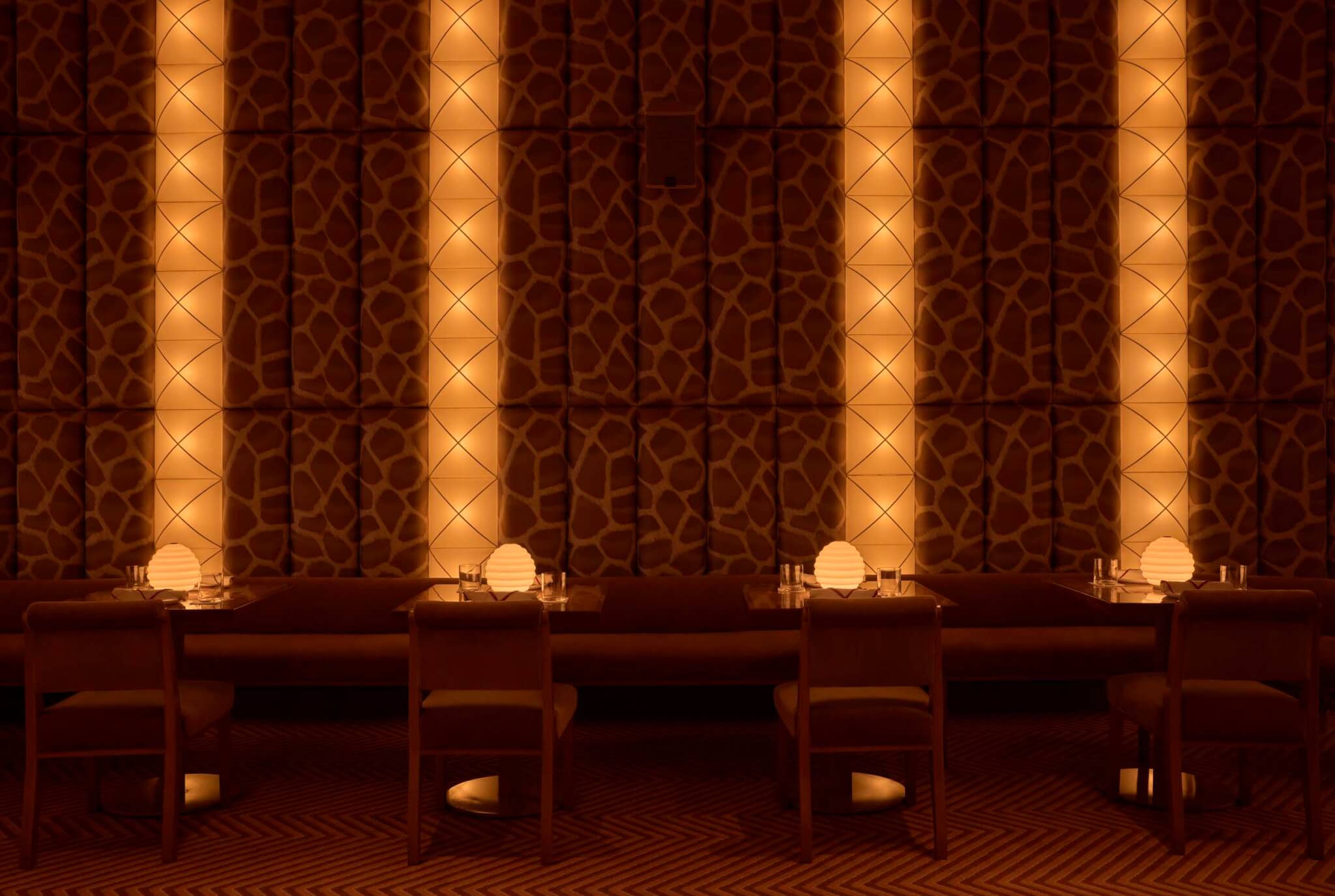
In New York, a new cocktail bar creates a romantic place using giraffe pattern silk brocade. It pads out the interior of Obvio designed by hospitality design firm Santa Cruz Co and hospitality group JF Restaurants. The space was shaped entirely by designer and founder of Santa Cruz Co, Juan Santa Cruz. He looked to the cinematography of Blade Runner and The Cook, the Thief, His Wife & Her Lover as well as places like Sirikoi Lodge in Kenya to create a new interpretation of neo-noir glamor.
The space uses curves to both organize the flow of the space and accentuate a sensual sculpture. Banquettes, for instance, snake through the interior’s perimeter to face the central bar. This leads the eye down the length of the room, while columns of wall lights create continuity and rhythm. Cruz designed everything in the space, from the giraffe brocade woven in Italy and the carpet made in England to the orb-like table lamps, tweaked to get the illumination just right for making strong eye contact.
NUMÉRO by Studio Kiff and Kevin Botchar Architect
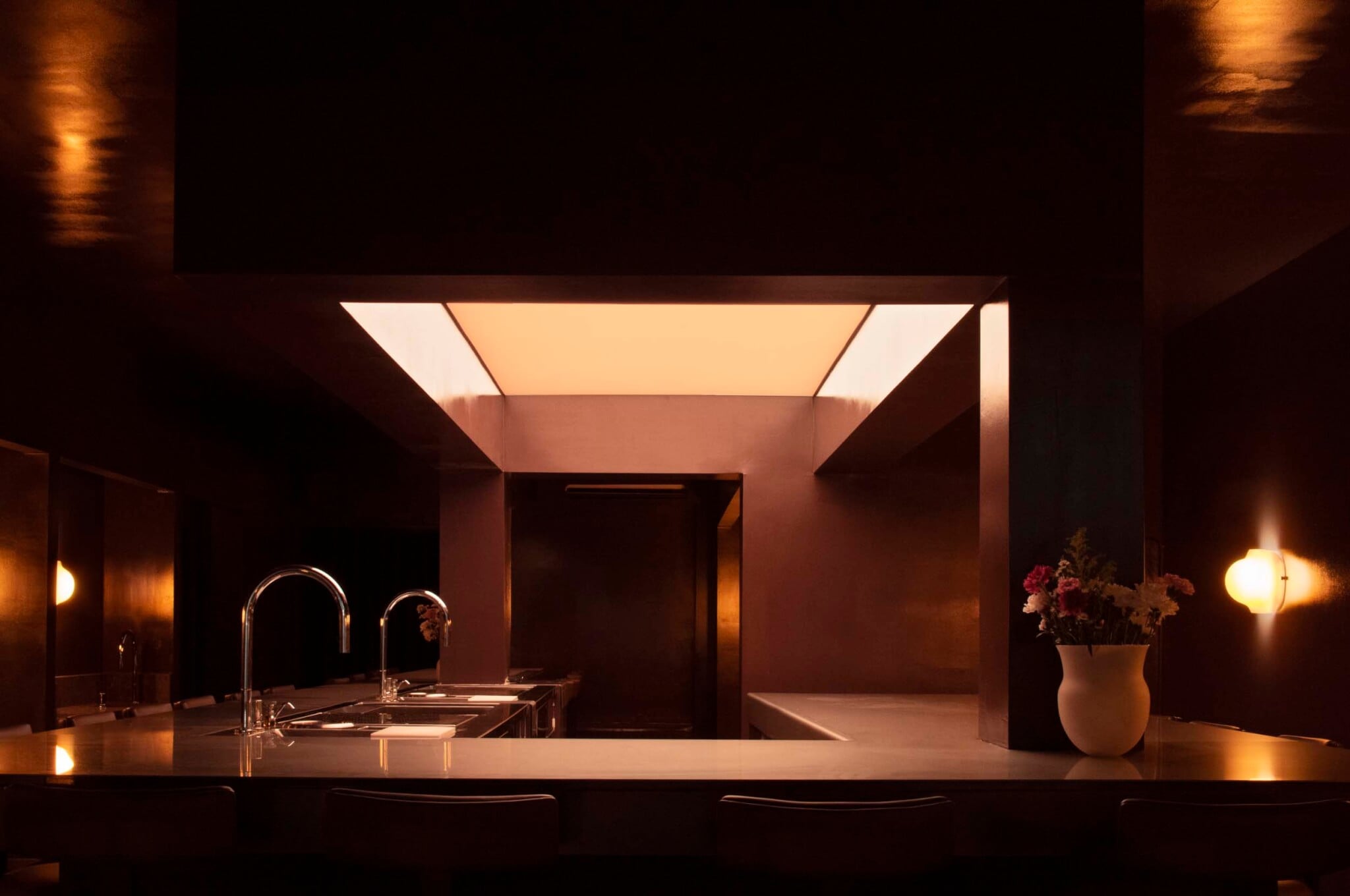
Of Obvio is a seductive spin on primal aesthetics, NUMÉRO is a sleek, sophisticated counterpart. With NUMÉRO’s clandestine lighting and refined edges, it’s easy to feel as swanky as James Bond when bellying up to this bar. Studio Kiff and Kevin Botchar Architect collaborated on the bar in Montreal, which opts for rectilinearity to create a sense of immersion. The compact site centers around a stainless steel bar. It’s topped by a lowered, bulky soffit housing an orange light installation, bolstering the bar’s commanding presence.
Glossy brown coats the walls, accented with hand-blown glass sconces from Verre d’Onge. The curvy forms of lighting form a warm contrast to the linear design, while the illumination is reflected against the many sleek surfaces of the bar. Lining the perimeter, suede banquettes and granite tables look toward the center, emphasizing the intimate and voyeuristic sensibilities of the design.